
Vietnam has become one of Southeast Asia’s most attractive places to do business with its strong economic growth, a young workforce and with a long list of free trade agreements. It's a go to choice for companies to expand their business into the region. But before you commit to setting up a company here in Vietnam, you will need to understand the cost of setting up your business.
This guide will help you break down the cost of setting up a company in Vietnam in 2026, from the initial government fees to ongoing operational items that catch many first-time investors by surprise. We will keep it practical, so you know what to budget for and where the money actually goes.
For a 100% foreign owned service company or trading company, the actual expenditure required to incorporate is often more modest than anticipated. The figure that inflates the headline total is the charter capital in which functions as your working capital rather than a fee payable to the authorities.
The table provides an indicative cost overview for establishing a standard service or trading business: -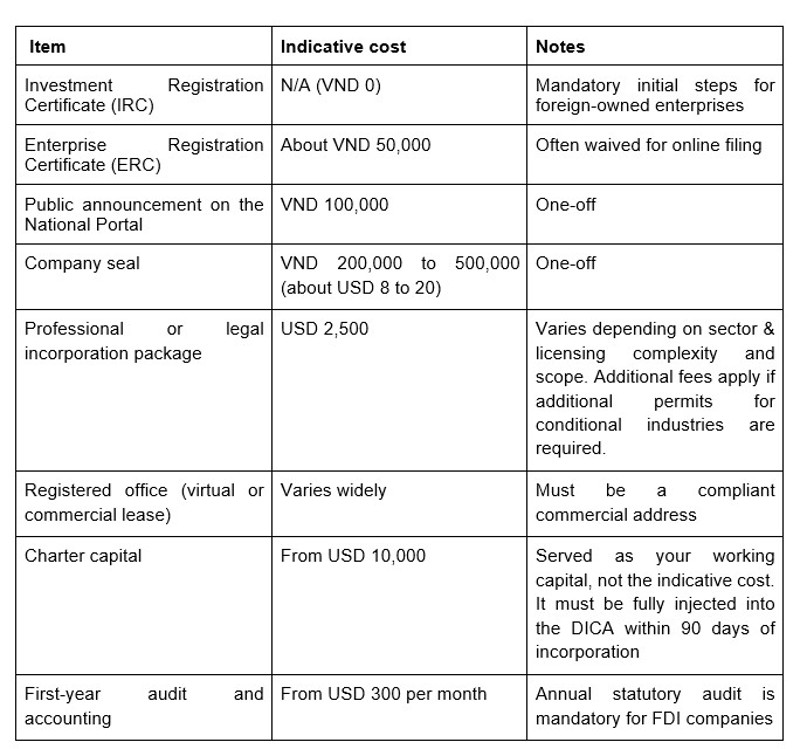
The final cost of setting up a company in Vietnam will vary according to your industry, your chosen location, and the scope of professional support you engage in.
The statutory fees payable to the authorities are modest. Vietnam has deliberately kept administrative charges low in order to encourage foreign direct investment.
For a foreign-owned enterprise, the initial and most critical step is obtaining the Investment Registration Certificate (IRC), for which the government charges no official licensing fee. The fee for an Enterprise Registration Certificate, following the IRC issuance, is approximately VND 50,000, which is frequently waived for applications submitted online through the National Business Registration Portal. A public announcement fee of VND 100,000 applies for publishing the company's details on the portal. The company seal, which continues to carry significant legal weight in Vietnam, costs in the region of VND 200,000 to 500,000 to produce.
Add it up and the state charges for incorporation come to a modest sum, usually a few hundred thousand Dong in total. The real budget sits in the items below.
Charter capital is often misunderstood, and it warrants careful attention.
Charter capital is the sum you commit to fund the business operation in Vietnam. It is not a fee paid to the government and it is not lost. Once the funds are deposited into your Direct Investment Capital Account (DICA) and verified, this can be used for your company’s active operating expenses, including office rent, salaries, equipment and other operating expenses.
Most service sectors are not subject to a fixed statutory minimum capital. In practice, however, the licensing authority expects a credible feasible figure to your business scale in Vietnam, and the right amount of approximately USD 10,000 is a common starting point for a service business. Regulated industries such as banking, insurance, and real estate are subject to considerably higher statutory minimums.
One requirement deserves particular attention: -
● Charter capital must be contributed into the DICA within 90 days of the ERC being issued
● Failure to meet the deadline for capital contribution above may result in an administrative fine of approximately VND 30 to 50 million (around USD 1,200 to 2,000), together with a mandatory reduction of the registered capital
● Determining the appropriate amount and meeting the deadline is therefore an important early decision.
Establishing a foreign-owned company in Vietnam involves more extensive documentation and additional licensing steps than a domestic incorporation. For this reason, most investors engage a law firm or corporate services provider to manage the process.
A standard incorporation package typically ranges from USD 2,500 to 5,000. This generally includes advice on the appropriate structure, the company certificates, the seal and the filings required to establish the entity. An experienced adviser will also help you to avoid common pitfalls, such as selecting a registered address that the authorities will not accept.
The right structure at the start affects your tax position, your licensing, and how easily you can grow later. With business support service specialists, it will help guide you through the structure that aligns with both your commercial objectives and complies with all the Vietnamese law.
Every company in Vietnam must maintain a registered office address, which must be legally leased commercial premises. This requirement is a frequent source of difficulty, as a significant proportion of delays affecting new foreign-invested companies arise from the use of residential or co-working addresses that do not satisfy the criteria.
For many service and technology businesses, a virtual office is entirely acceptable and keeps this expense to a minimum. Where a physical presence is required, leasing costs differ considerably between Ho Chi Minh City, Hanoi, and other cities, and should be budgeted according to your location and sector.

Foreign investors generally require two principal documents to start their operations in Vietnam:
The IRC authorises the foreign investment project. It is issued by the relevant provincial authority and ordinarily takes approximately 15 working days from the submission of a valid dossier.
The ERC serves as the business licences and it establishes the company as a legal entity and functions as its tax identification number. The ERC is generally issued within three working days, provided the application is complete and correctly prepared.
Incorporation marks the beginning rather than the conclusion of your financial commitments in Vietnam. A sound budget should account for recurring costs as well.
Every foreign-invested company is required to complete a mandatory annual statutory audit, with audit fees generally commencing from around USD 300 per month. Ongoing accounting and tax filing support is also necessary to maintain compliance.
Where staff are employed, the employer contributes approximately 21.5% of each employee's gross salary towards social, health, and unemployment insurance. Companies with a trade union contribute a further 2% of payroll. For foreign employees, a work permit costs in the region of USD 600 to 1,000 per person, and a Temporary Residence Card adds a further USD 300 to 600.
These recurring obligations frequently exceed the one-off cost of incorporation, and are best anticipated from the outset.
The annual business licence fee, a recurring levy of VND 1 to 3 million based on charter capital, was abolished with effect from 1 January 2026. Online enterprise registration is now linked to a national electronic identification (VNeID) account, rendering the process considerably more digital than before. As noted above, the new ERC-first sequencing also allows an entity to be established sooner.
Collectively, these reforms reduce both the cost and the administrative friction of market entry, a welcome development for businesses considering Vietnam.
No two incorporations carry identical costs. Your total will vary according to several factors:
● Your industry, as conditional or regulated sectors entail higher capital and licensing requirements
● Whether the entity is 100% foreign-owned or structured as a joint venture
● Your location and choice of office
● The number of foreign employees requiring work permits
● The scope of professional support you engage
The cost of setting up a company in Vietnam is entirely manageable once each element is properly understood, yet the details are decisive. An unsuitable structure, a non-compliant address, or a missed capital deadline can prove far more costly than the registration fees themselves.
Kelvin Chia Partnership has maintained a presence in Vietnam for decades, with offices in Hanoi and Ho Chi Minh City and one of the longest track records of any international firm in the market. Through our business support services, we guide foreign investors through every stage of establishing a company in Vietnam: choosing the appropriate structure, preparing the licensing, and meeting your capital and compliance obligations.
Kelvin Chia Partnership has maintained a presence in Vietnam for decades, with offices in Hanoi and Ho Chi Minh City and one of the longest track records of any international firm in the market. Through our business support services, we guide foreign investors through every stage of establishing a company in Vietnam: choosing the appropriate structure, preparing the licensing, and meeting your capital and compliance obligations.
To discuss your plans and obtain a clear, tailored estimate of the cost of setting up a company in Vietnam, contact our team. We will help you structure your entry correctly and budget with confidence from the first step.